When a single-phase pump hums but won't start, runs hot, or trips the breaker, the capacitor is the usual culprit. It's a cheap film or electrolytic can inside the motor terminal box that dries out and loses capacitance with age, and replacing it is one of the most common DIY pump fixes there is. The whole trick is matching three things: the right µF (capacitance), the right voltage, and the right type. Get those right and a $20 part saves you a $400 motor or a whole new pump. This guide walks through how a pump capacitor works, how to tell when it's failed, and how to pick the exact replacement.
Popular pump capacitors
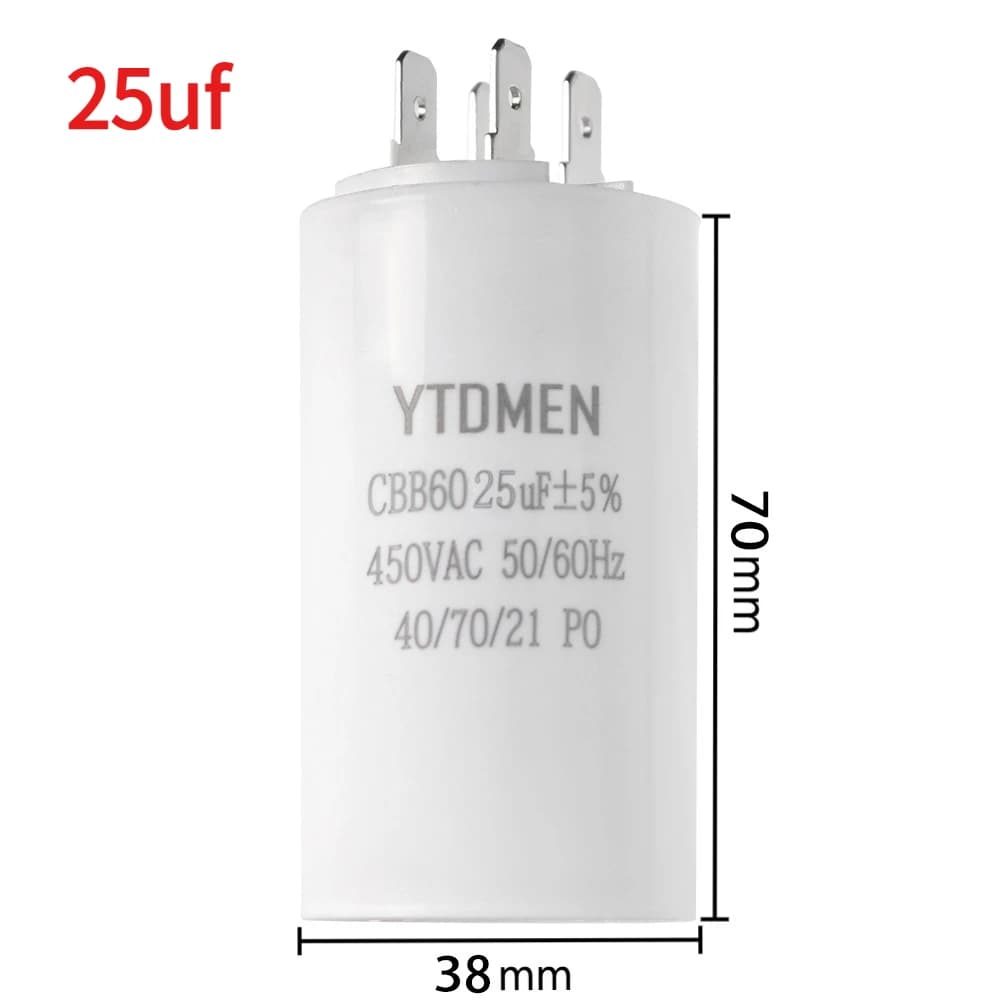
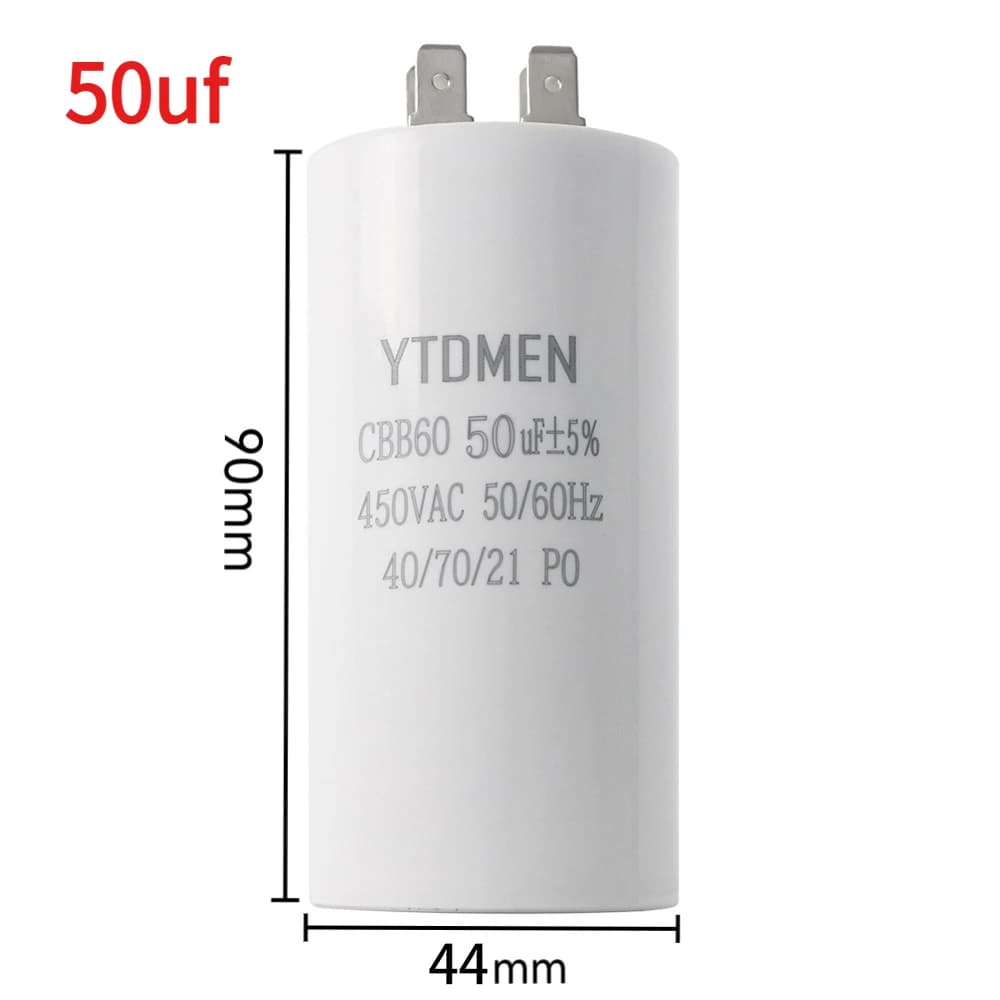
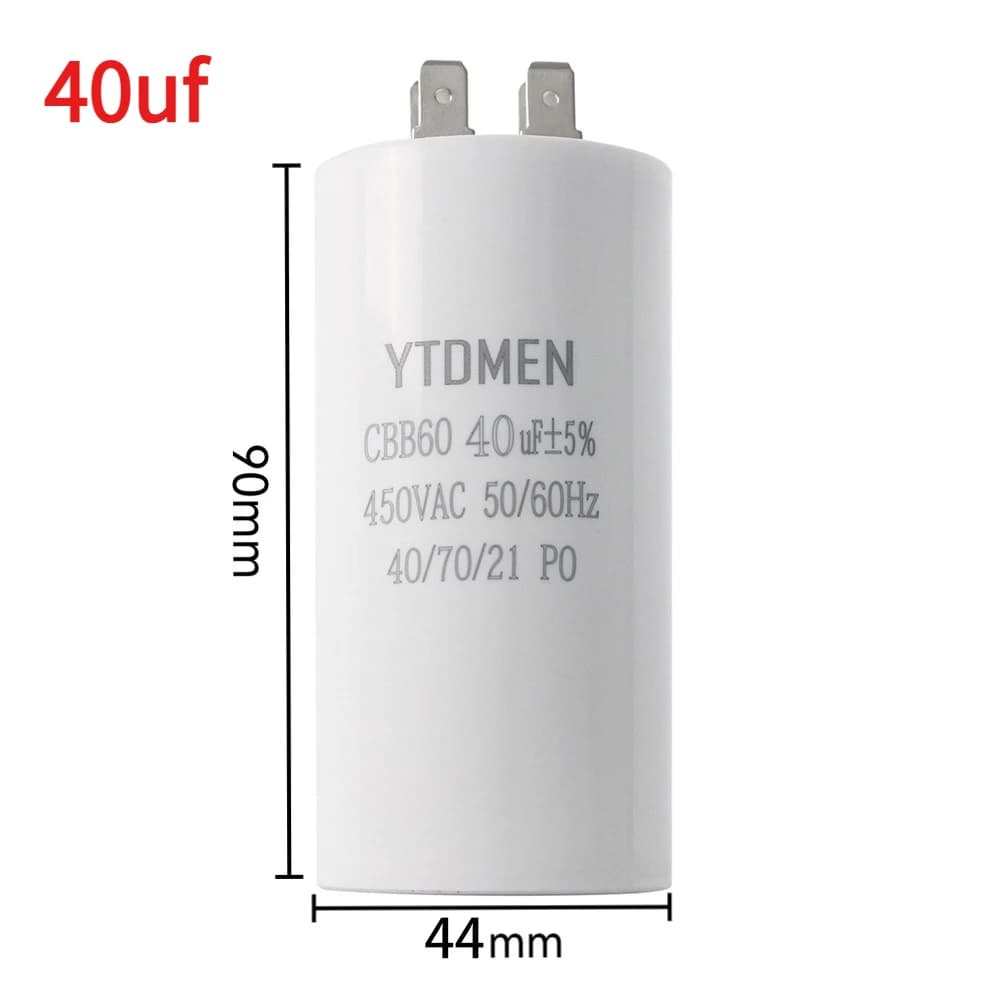
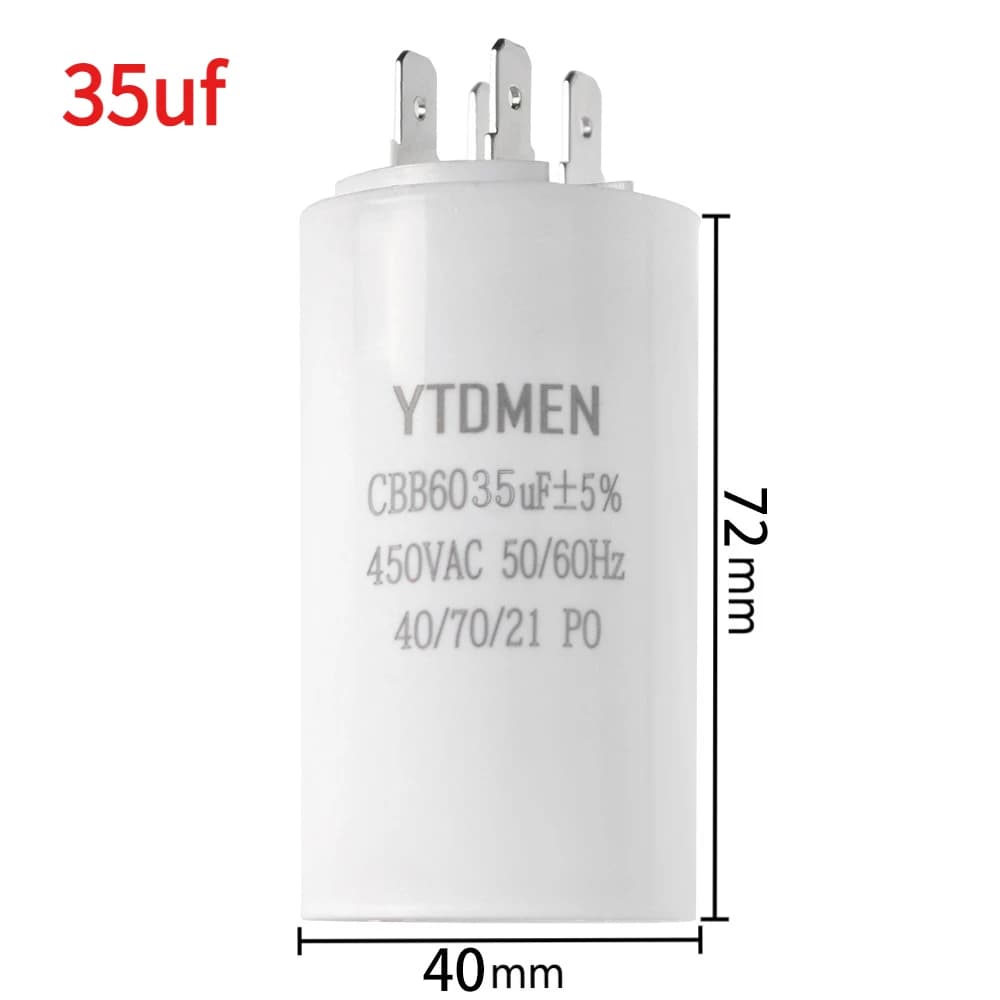
Larger run capacitors: 55-80µF. Bigger pool and bore pump motors can take a run capacitor above 50µF: match the µF printed on your old one.
CBB60 run capacitors, 450V
Every value from 4µF up, by terminal: all CBB60 capacitors.
Find the right pump capacitor
Capacitors by pump brand
Know your pump's make and model? Our brand fitment pages list the run capacitor (µF and voltage) for each model, with the matching replacement capacitor. Jump straight to yours:
- Davey pump capacitors
- Bianco capacitor fitment by model
- Capacitors for DAB pumps
- Onga pump capacitors
- Grundfos capacitor fitment by model
- Capacitors for Waterco pumps
- AstralPool pump capacitors
- Hayward capacitor fitment by model
- Capacitors for LX pumps
- Pentair pump capacitors
Don't see your brand? Browse the full pump capacitor finder. We cover 24 pump brands and add models as we confirm them. Servicing the whole pump? See the seal, capacitor and bearing kits listed by pump model.
How a pump capacitor works (and why it fails)
Most modern pool, spa, pressure and bore pumps run a permanent-split-capacitor (PSC) motor. The capacitor sits across an auxiliary winding and creates the phase shift the motor needs to start turning and to run efficiently. Without a healthy capacitor the motor has no starting torque: it just buzzes, draws a heavy stalled current, and quickly overheats. A few higher-torque or older designs add a separate start capacitor that gives a bigger kick for the first second and then switches out.
Capacitors are consumables. The dielectric film (or the electrolyte in a start cap) degrades with heat and time, so capacitance slowly drifts down until the motor can no longer start reliably. NZ pump sheds get hot, pumps cycle hard over summer, and voltage spikes don't help, so a capacitor lasting only a few years is normal, not a sign the pump itself is worn out. That's good news: the cheapest part is usually the one that failed. More on why capacitors fail: heat, voltage and age.
Run vs start: which does my pump use?
- Run capacitor (CBB60 / CBB65): a film capacitor that stays in the circuit the whole time the motor runs. Smaller µF (tens of microfarads), high voltage (typically 400-450V). Most modern pool and pressure pumps are PSC motors that use a single run cap.
- Start capacitor (CD60): an electrolytic capacitor that's only in circuit for the first second or two to give a strong starting kick, then switched out. Larger µF (often into the hundreds), lower voltage (around 250V). Seen on some higher-torque or older pumps.
Not sure which you have? See run vs start capacitors explained, or read the markings off your own can and we'll match it. New to the part itself? Start with what a run capacitor actually does.
µF and voltage: reading the label
Every capacitor is printed with the two numbers that matter. The capacitance is shown in microfarads, something like 30 µF, 35 µF or µF / MFD (all the same unit). The voltage is the maximum AC working voltage, usually 370V, 440V or 450VAC. Many caps also show a tolerance such as ±5% and a temperature/class rating you can ignore for matching.
The golden rule: match the µF, and match or exceed the voltage. Keep the capacitance the same, match the µF on the label; within ±5% is fine. Too low and the motor won't start, too high and it runs hot and cooks the windings. Voltage can go up but never down: a 450V capacitor safely replaces a 370V or 440V one, and using a higher-rated cap actually runs a little cooler and lasts longer. Frequency (50/60 Hz) and tolerance don't need an exact match. There is no single "correct" capacitor for a given pump model: even identical-looking pumps can ship different values, so the rating on your own part is always the final word. More on why the µF matters more than the voltage. Line by line: how to read a pump capacitor label, and reading a CBB60 label line by line.
Signs your pump capacitor is failing
A failing run capacitor rarely dies all at once. It usually announces itself first. Watch for:
- Hums but won't spin up. The classic symptom: you hear the motor buzz, maybe give it a nudge and it runs: that's a weak or dead capacitor.
- Slow or struggling start. The pump takes a few seconds to get going, or only starts sometimes.
- Runs hot or trips the breaker / overload. A wrong-value or failing cap makes the motor draw too much current.
- Bulging top, split casing, or leaking oil. A capacitor that's physically deformed has already failed. Replace it, don't test it.
- Pump won't build pressure / weak flow. On pressure and bore pumps a tired cap can leave the motor running under-powered.
You can confirm with a multimeter in capacitance (µF) mode and compare against the printed rating: a reading well below spec (or zero) means it's done. Here's how to test a pump capacitor with a multimeter. Not sure whether it's the capacitor or the motor itself? This walkthrough helps you tell them apart. The symptoms in more depth: 5 signs your pump capacitor is failing, and what to check when a pool pump hums but won't start. Spa pump doing the same? Spa pump hums but won't start covers the controller and seized-shaft checks too. Bore pump running for a few minutes and then tripping? Bore pump starts then cuts out walks through it.
How to identify and read your capacitor
The capacitor lives in the terminal box on the motor: usually a small cover on the back or top of the motor, or a cylindrical can clamped to the side. Isolate the power first (see the safety note below), then open the cover and you'll find a small plastic block (CBB60), a round metal can (CBB65/CD60), or a cap on flying leads. Note how the wires connect: spade lugs, flying leads, or a stud, because the replacement needs to physically fit, even though the terminal style doesn't change the electrical match.
Read the µF and voltage off the side of the can and write them down (or photograph the label). If the print has worn away or the can is bulged and unreadable, the motor nameplate often lists the run-capacitor value, or you can identify a failed run capacitor by its markings and shape. Only have the OEM part number? Cross-reference it to a µF and voltage first. Still stuck? Send us a clear photo of the capacitor and the motor plate and we'll tell you what fits: that's what the find-my-part finder and our inbox are for.
Replacing a pump capacitor, step by step
A pump capacitor holds a dangerous charge even when the pump is off and unplugged. In New Zealand, fixed mains wiring is work for a licensed electrician. If your pump is hard-wired (not on a plug) or you're unsure at any point, stop and use one. For a plug-in pump with a replaceable capacitor, the job goes like this (our pool pump capacitor replacement guide covers each step in full):
- Isolate the power. Switch off and unplug the pump, or turn off the breaker for a hard-wired unit, and confirm it's dead.
- Open the terminal box and locate the capacitor (plastic block, metal can, or a cap on flying leads).
- Discharge the capacitor before touching the terminals: bridge the terminals with an insulated screwdriver across a bleed resistor, or use a proper discharge tool. Never short it directly.
- Photograph the wiring and note which lead goes where, then read the µF and voltage off the old cap.
- Remove and match. Unclip the old capacitor and order a replacement with the same µF and an equal-or-higher voltage, in a terminal style that fits.
- Fit the new cap, reconnect the leads exactly as before, close the terminal box, restore power and test.
Pump leaking at the shaft while you're in there? The mechanical seal is the other common wear part: how to identify your pump's mechanical seal.
Our step-by-step install guides walk through the job for common pumps:
Pool & spa pumps
- Pool Pump Capacitor Replacement: Steps, Sizes & Safety (NZ)
- Spa pool pump capacitor replacement (NZ)
- How to replace a Davey pool pump capacitor
- Onga Pool Pump Capacitor Replacement (Pantera, Leisuretime) - NZ
- Hayward Super Pump Capacitor Replacement: 30-Min DIY (NZ)
- Pentair pool pump capacitor replacement
- Waterco pool pump capacitor replacement
Pressure & bore pumps
Not a pump?
CBB60, CBB65 or CD60: which body do I need?
The body code tells you the construction, and they aren't interchangeable. Match the one your pump already uses:
| Type | Role | Typical rating | Found on |
|---|---|---|---|
| CBB60 | Run (film) | ~4-60 µF, 450VAC | Most pool, spa, pressure & bore pumps |
| CBB65 | Run (film, round metal can) | ~25-70 µF, 450VAC | HVAC, some larger motors, dual-run units |
| CD60 | Start (electrolytic) | ~50-400+ µF, ~250VAC | Higher-torque / older pumps, briefly at start |
CBB60 and CBB65 are both film run capacitors (CBB60 in a plastic case, CBB65 in a round metal can); CD60 is an electrolytic start capacitor. Full breakdown in CBB60 vs CBB65 vs CD60. Label says CBB61? CBB60 vs CBB61 explains the difference.
We carry CD60 start capacitors at 250VAC from 50 to 500µF. Only fit one if your pump already has a separate start can. Start caps are printed with a µF range rather than one value, how to size a CD60 start capacitor explains how to read it.
CD60 start capacitors, 250V
All motor start capacitors: sizing a printed range, voltage and typical values by appliance.
Common questions
How do I know if my pump capacitor is bad?
The classic sign is a motor that hums but won't spin up, starts slowly, runs hot, or trips the breaker. A bulging top, split casing or leaking oil means it's failed: replace it. You can also test it with a multimeter in capacitance (µF) mode and compare against the printed rating. See how to test a pump capacitor.
What size capacitor does my pump need?
The size printed on your existing capacitor or the motor nameplate: don't guess from the pump model or horsepower. Match the µF exactly and use a voltage rating equal to or higher than the original. More on what size capacitor a pool pump needs.
Can I use a higher µF or voltage?
A higher voltage rating is fine and often sensible (e.g. swapping a 400V for a 450V). A different µF is not: capacitance changes the motor's torque and current, so keep it the same. See can I use a higher µF or voltage capacitor.
CBB60, CBB65 or CD60: what's the difference?
CBB60 and CBB65 are film run capacitors (CBB60 in a plastic case, CBB65 in a round metal can); CD60 is an electrolytic start capacitor. They aren't interchangeable. Full breakdown in CBB60 vs CBB65 vs CD60.
My pump has a two- and a three-terminal capacitor: what's the difference?
A standard run capacitor has two terminals (or two pairs of spades). A dual-run capacitor has three terminals and combines two capacitors in one can (common in HVAC, occasionally larger pumps): match the labelling on each terminal, not just the total µF. See 2- vs 3-terminal capacitor wiring.
My pressure pump won't build pressure. Is it the capacitor?
It can be. A weak run capacitor leaves the motor under-powered, so the pump runs but never reaches cut-off pressure. Rule out a stuck pressure switch and a primed wet end first, then check the capacitor. More on a pressure pump that won't build pressure.
Do you deliver in New Zealand?
Yes, ships from New Zealand via NZ Post, tracked. Prices in NZD, with a 90-day DOA guarantee. NZ-owned and operated.