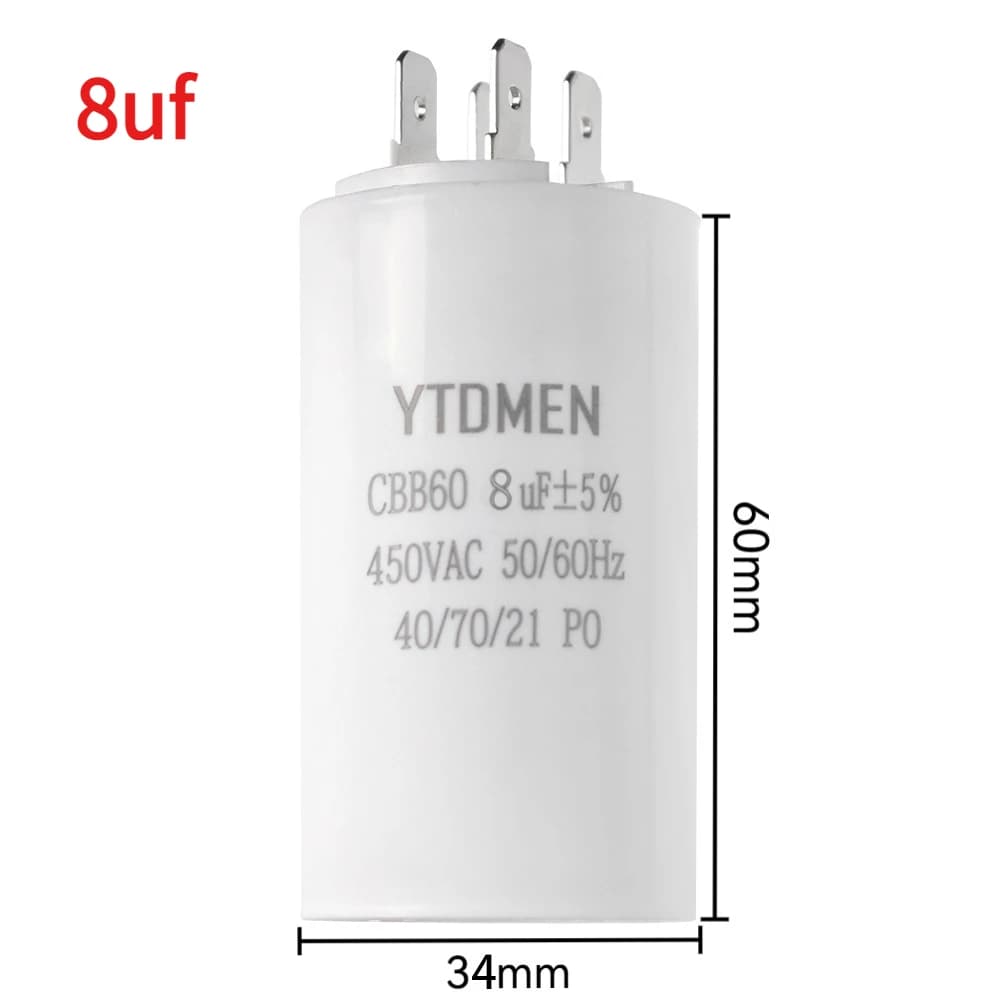
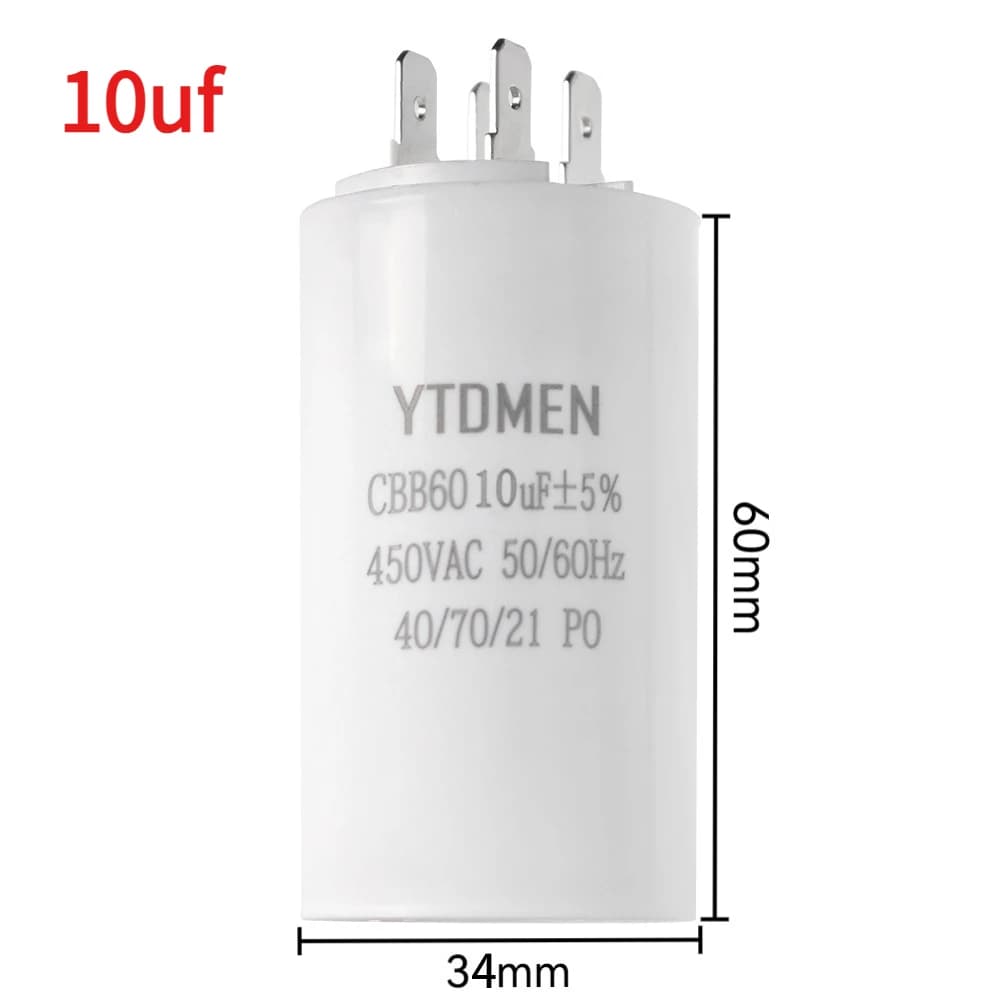
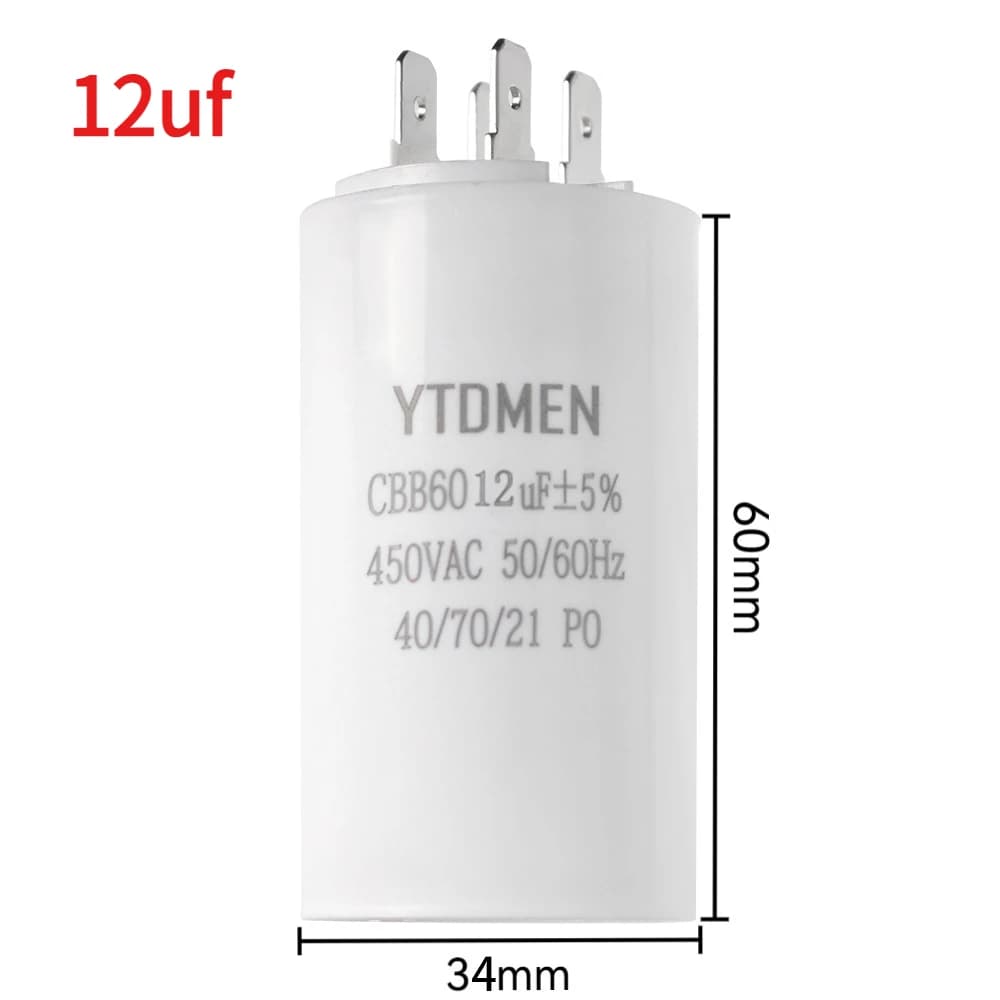
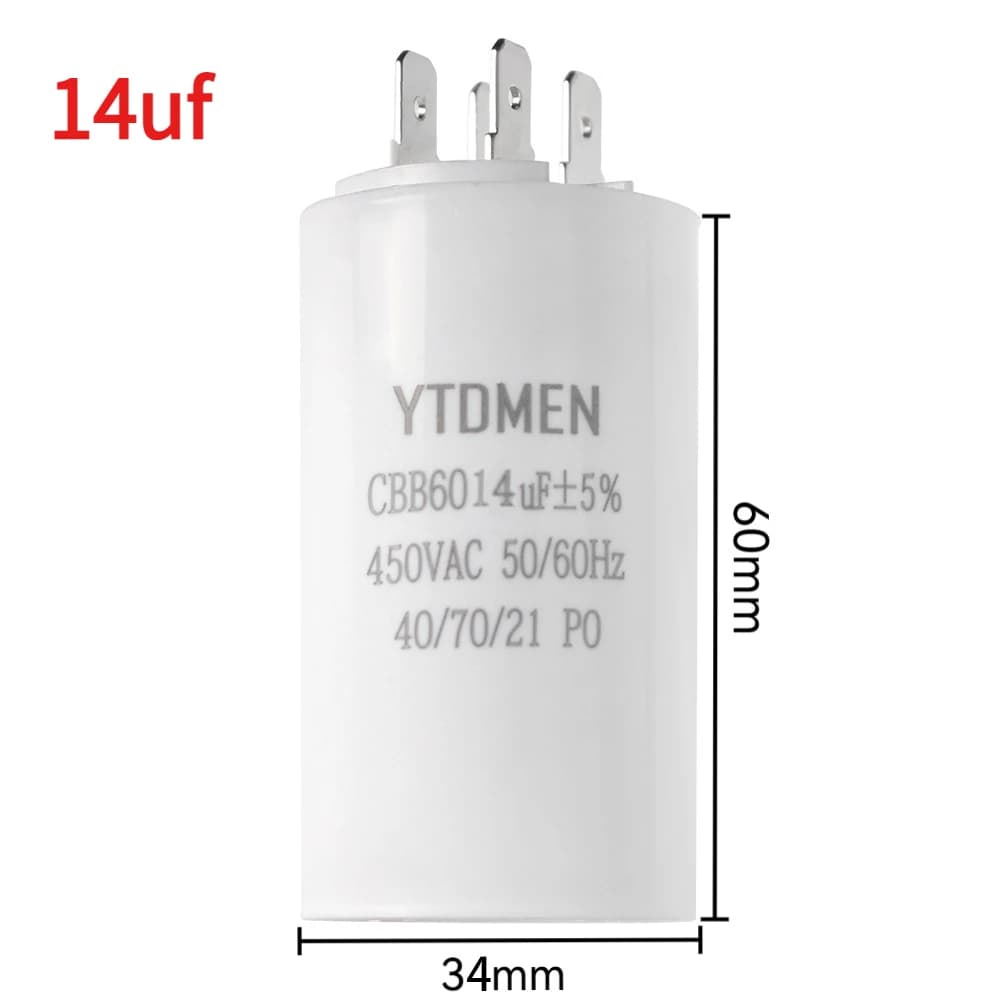
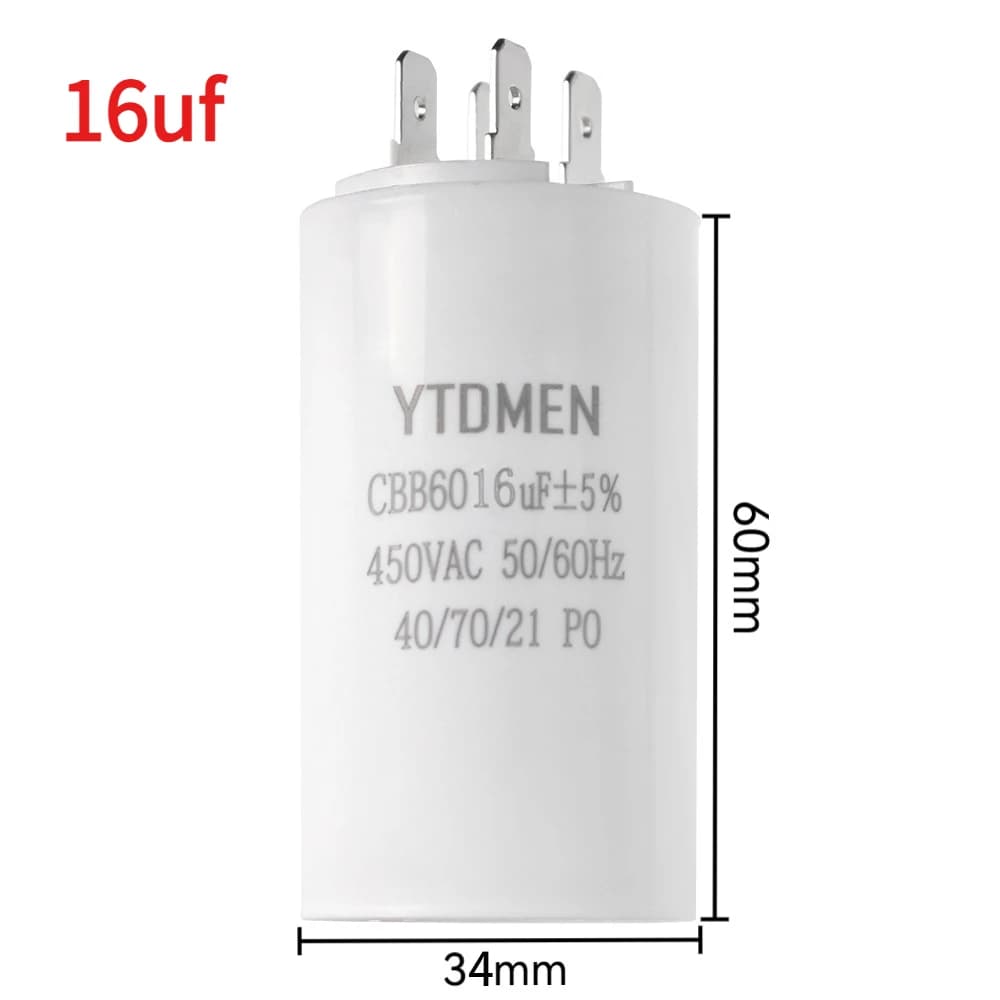
Most NZ top-loaders take 10-12µF. 12µF is the most common single value. The figure is printed on the old capacitor's body (e.g. "12µF ±5%"). Example: 12µF · 450VAC CBB60. Not sure how to read your old label? Here's how, in 60 seconds.
Does your washing machine have a capacitor?
Not every machine has one, if yours doesn't, no capacitor will fix it. Check the motor type before you order:
| Motor type | How to recognise it | Run capacitor? |
|---|---|---|
| Direct-drive brushless (Fisher & Paykel SmartDrive, LG Direct Drive) | No belt: the motor sits directly on the drum shaft | No |
| Belt-drive universal (brushed) motor | A belt, plus a motor with visible carbon brushes | No, speed is board-controlled |
| Belt-drive induction motor | A belt, a smooth cylindrical motor, and a capacitor on a bracket nearby | Yes, typically 8-16µF |
Matching the µF and voltage
Belt-drive washing machines with an induction motor (mostly top-loaders) use a motor run capacitor to start and steady the motor: when it weakens the machine hums, trips, or won't spin. Direct-drive machines (Fisher & Paykel SmartDrive, LG Direct Drive) and brushed-motor machines don't have one. Values are typically 8-16µF, most commonly 10-12µF; a 450V capacitor safely replaces a 370V or 440V original as long as the µF is the same. Read the µF off your own capacitor before ordering (e.g. "12µF ±5%"). Match the µF on the label; within ±5% is fine.
Washing machine run capacitors are CBB60-bodied film capacitors. If your old one is a flat rectangular box (CBB61) or a round metal can (CBB65), those types aren't in our range: run your numbers through the finder or ask us.
Before you order
- Washing machine won't spin: is it the capacitor?
- How to test a capacitor with a multimeter
- Step-by-step: replace a washing-machine motor capacitor
- Not sure of the µF? Use the find-my-part wizard
Washing machine capacitor FAQ
Does every washing machine have a capacitor?
No. Direct-drive machines such as Fisher & Paykel SmartDrive and LG Direct Drive have no motor run capacitor, and belt-drive machines with a brushed (universal) motor don't use one either. Belt-drive machines with an induction motor (mostly top-loaders) do. Unplug the machine and look behind the rear panel: a belt plus a small plastic cylinder on a bracket near the motor means it has one.
What size capacitor does a washing machine use?
Typically 8-16µF, most commonly 10-12µF, usually rated 370-450V. The exact value is printed on your old capacitor, for example "12µF ±5% 450VAC". Match the µF on the label; within ±5% is fine. Don't buy by machine model, manufacturers change motors mid-production.
Can I use a 450V capacitor to replace a 370V or 400V one?
Yes. The voltage rating is a maximum, so the same or higher is fine, never lower. A 450V capacitor safely replaces a 370V, 400V or 440V original as long as the µF is the same.
How much does a washing machine capacitor cost?
Our washing machine capacitors (8, 10, 12, 14 and 16µF, CBB60, 450V) start from $24.95 NZD. The price depends on the µF and the terminal style: each product page shows the price for every terminal.
Can I fit a CD60 start capacitor instead?
No. A washing machine's run capacitor stays in circuit the whole time the motor runs; a CD60 start capacitor is built for a second or two at start-up. They are not interchangeable in either direction.