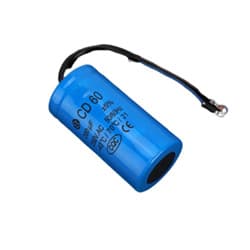
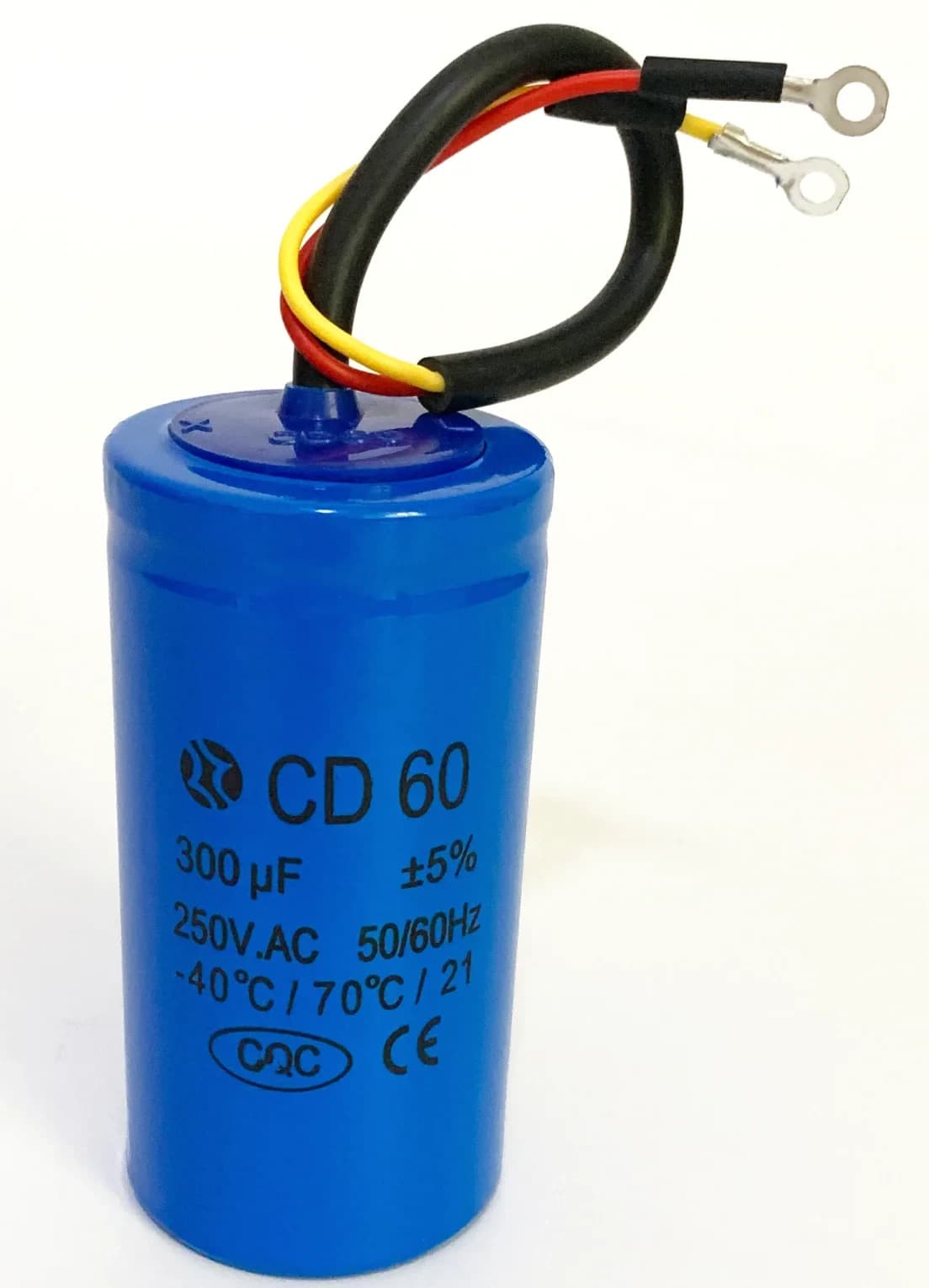
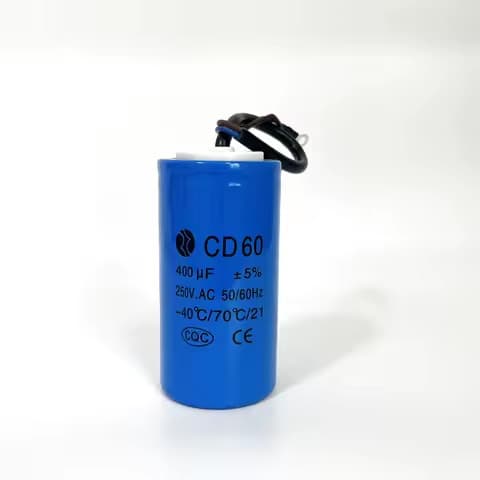
Is it a start capacitor?
Check the body code and the voltage before you order. A start capacitor is usually marked CD60, carries a large µF figure (often printed as a range such as 161-193 MFD) and is rated around 250VAC or lower. A plastic block or metal can marked CBB60 or CBB65, rated 370-450VAC with a smaller µF, is a run capacitor, see our CBB60 run capacitors instead. Some motors carry both, side by side; replace each with its own type. Run vs start capacitors explained.
Typical start-capacitor values by appliance
Typical ranges, not a fitment guarantee: the value printed on your own capacitor always wins.
| Appliance | Typical start capacitor |
|---|---|
| Pool & spa pumps | 150-300µF · 250V |
| Well & domestic pumps | 100-300µF · 250V |
| Fridges & freezers | 50-150µF · 250V |
| Garage door openers | 150-250µF · 250V |
| Compressors & air tools | 50-500µF · 250V |
Most NZ pool and pressure pumps are permanent-split-capacitor motors that use only a run capacitor; a start capacitor shows up on higher-torque and capacitor-start motors. Don't guess the value from the motor's kilowatts or copy another pump of the same brand.
Before you order
- Motor start capacitor (CD60): size, test and replace
- CBB60 vs CBB65 vs CD60: which capacitor do I need?
- How to test a capacitor with a multimeter
- Need a run capacitor? All CBB60 values
A start capacitor stores a hefty charge after the power is off. Isolate the supply and discharge it before touching the terminals, and use a registered electrician for hard-wired equipment or if you're not confident working on mains.
Motor start capacitor FAQ
What's the difference between a start capacitor and a run capacitor?
A start capacitor (CD60) is an electrolytic capacitor that gives a single-phase motor a strong kick for about a second at start-up, then a centrifugal switch, relay or PTC device takes it out of circuit. A run capacitor (CBB60 or CBB65) is a film capacitor that stays in circuit the whole time the motor runs, with a smaller µF at a higher voltage. They are never interchangeable, in either direction.
My old start capacitor shows a range like 161-193µF. Which one do I buy?
Choose a listed value inside the printed range where one exists. If none sits inside it, pick the listed value at or above the bottom of the range, never below it, or the motor won't have the torque to break away. For 161-193µF that is 200µF, about 4% above the top of the range. If the next listed value would be more than about 5% above the top of your range, ask us before ordering. If the label prints a single value, match the µF; within ±5% is fine.
Can a 250V start capacitor replace a 125V or 220V one?
Yes. The voltage rating is a maximum, so the same or higher is fine, never lower. A 250V CD60 replaces start capacitors marked 110V, 125V, 165V, 220V or 250V. It does not replace one marked 330V or higher.
How much does a motor start capacitor cost?
Our CD60 start capacitors (50, 75, 100, 150, 200, 250, 300, 350, 400, 450 and 500µF, 250VAC, flying lead) start from $49.95 NZD. Each product page shows the price and delivery time for that value.
Is a 50µF or 75µF start capacitor the same as a run capacitor of the same µF?
No. We list 50µF and 75µF as both a CD60 start capacitor and a CBB60 run capacitor, and they are different parts for different jobs. Check the body code and voltage on your old capacitor: a CD60 start capacitor is rated around 250VAC for intermittent start duty, while a CBB60 run capacitor is rated 450VAC for continuous duty.
Run capacitors at the same µF: 50µF 450V CBB60 run capacitor, 75µF 450V CBB60 run capacitor.