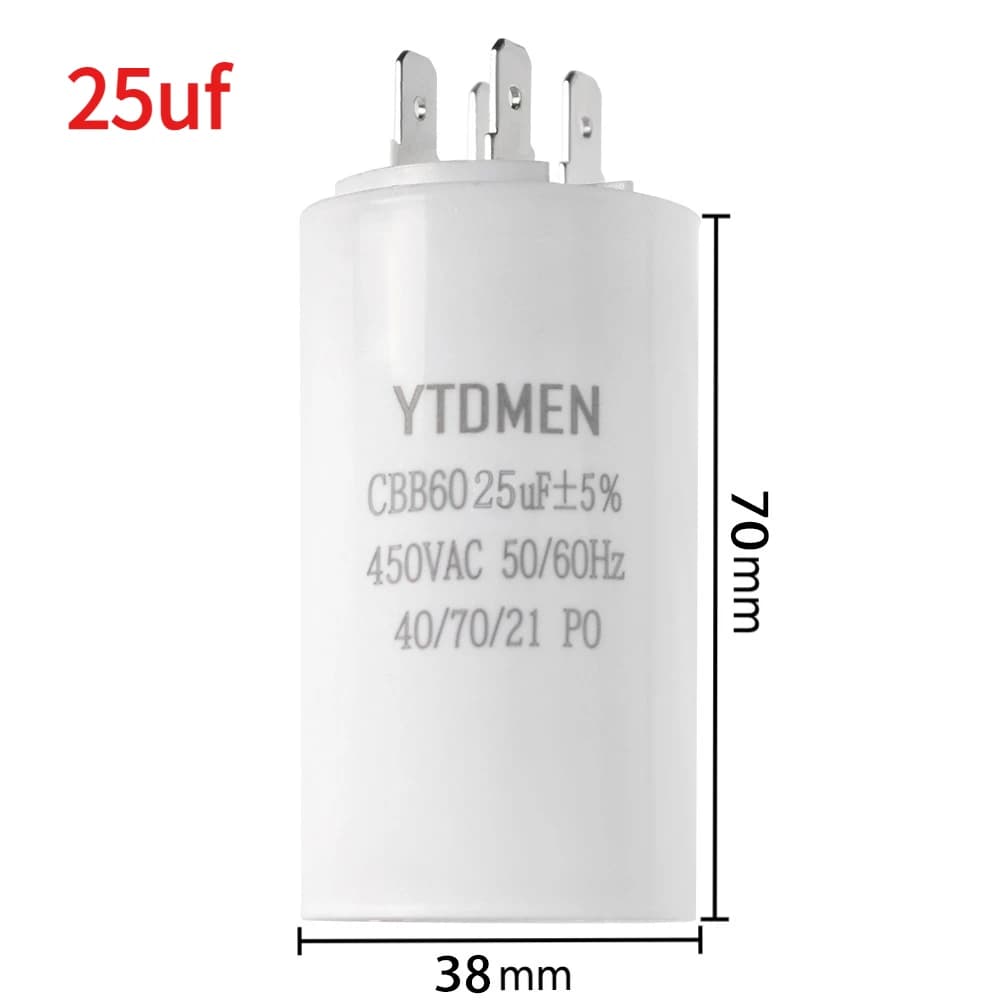
The run capacitor listed for the Davey Silensor SLL300 is 25 µF (25 uF / 25 MFD) at 450 VAC, in a CBB60 motor-run body with lug (spade) terminals. This CapacitorsNZ aftermarket part suits the SLL300’s single-phase motor. Before you order, read the µF value printed on your old capacitor: if it reads 25 µF this is the value to order, and if it shows another value, order that value instead.
Choosing the right capacitor for the Davey Silensor SLL300
Three things need to line up. The capacitance must match the old capacitor, normally within 5%, because a wrong value makes the motor run hot or weak. The voltage must be the same or higher than the old one, never lower; this part is 450 VAC. And the terminals and body need to fit the motor’s wiring and space; this part has lug (spade) terminals on a CBB60 body, so check your old one matches.
The value is printed on the side of the old capacitor as µF, uF or MFD, often with a tolerance such as ±5%. Our Silensor SLL capacitor guide has the capacitor details for this range.
Signs the SLL300 run capacitor is failing
On a single-phase motor like the SLL300’s, the run capacitor stays in circuit the whole time the pump runs, so it ages with heat and use.
- The motor hums but won’t turn, or only starts if the shaft is given a spin.
- The pump trips the safety switch or the motor overload soon after starting.
- The motor runs hot, slow or noisy compared with normal.
- The old capacitor is swollen, cracked or leaking.
Other Silensor pumps listed at 25 µF
The same 25 µF rating is listed for the Silensor SLL150, Silensor SLL200, Silensor SLL400 and Silensor SLS300. Those listings help you identify your pump, but motors can be changed or rewound over the years, so the number on your old capacitor is the one to trust.
The same capacitor is also sold on its own as our 25 µF 450 V CBB60 capacitor. If you are also chasing a leak, the SLL300 service kit pairs this capacitor with the shaft seal. Parts for other models are on our Davey service kits page.
Swapping the SLL300 capacitor safely
Switch off and unplug the pump before opening the capacitor cover. A capacitor can hold a charge after the power is off, so discharge it safely before touching the terminals, and leave it to an electrician if you are unsure. Take a photo of the wiring first so each lead goes back on the same terminal.
Before you order
Check the old part before fitting: match the µF printed on your old capacitor.